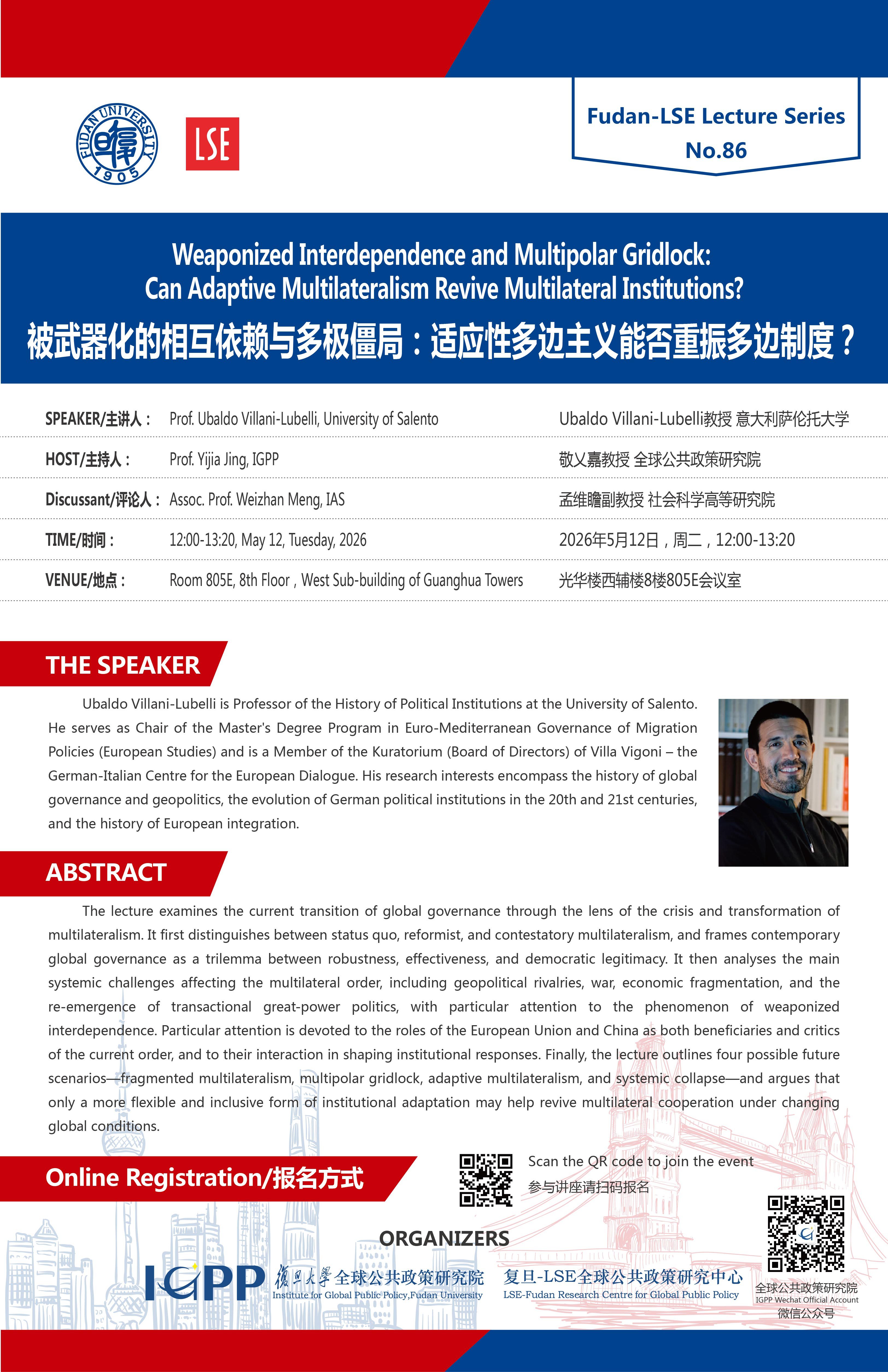
被武器化的相互依赖与多极僵局:适应性多边主义能否重振多边制度?
The lecture examines the current transition of global governance through the lens of the crisis and transformation of multilateralism. It first distinguishes between status quo, reformist, and contestatory multilateralism, and frames contemporary global governance as a trilemma between robustness, effectiveness, and democratic legitimacy. It then analyses the main systemic challenges affecting the multilateral order, including geopolitical rivalries, war, economic fragmentation, and the re-emergence of transactional great-power politics, with particular attention to the phenomenon of weaponized interdependence. Particular attention is devoted to the roles of the European Union and China as both beneficiaries and critics of the current order, and to their interaction in shaping institutional responses. Finally, the lecture outlines four possible future scenarios—fragmented multilateralism, multipolar gridlock, adaptive multilateralism, and systemic collapse—and argues that only a more flexible and inclusive form of institutional adaptation may help revive multilateral cooperation under changing global conditions.
报告介绍
报告人介绍
报告图片 共 3 张