
加入支持让我们有继续维护的动力!会员畅享查看所有预告
立即购买
【讲座预告】被武器化的相互依赖与多极僵局:适应性多边主义能否重振多边制度?
- 来源:
- 学校官网
- 收录时间:
- 2026-06-25 12:19:31
- 时间:
- 2026-05-12 12:00:00
- 地点:
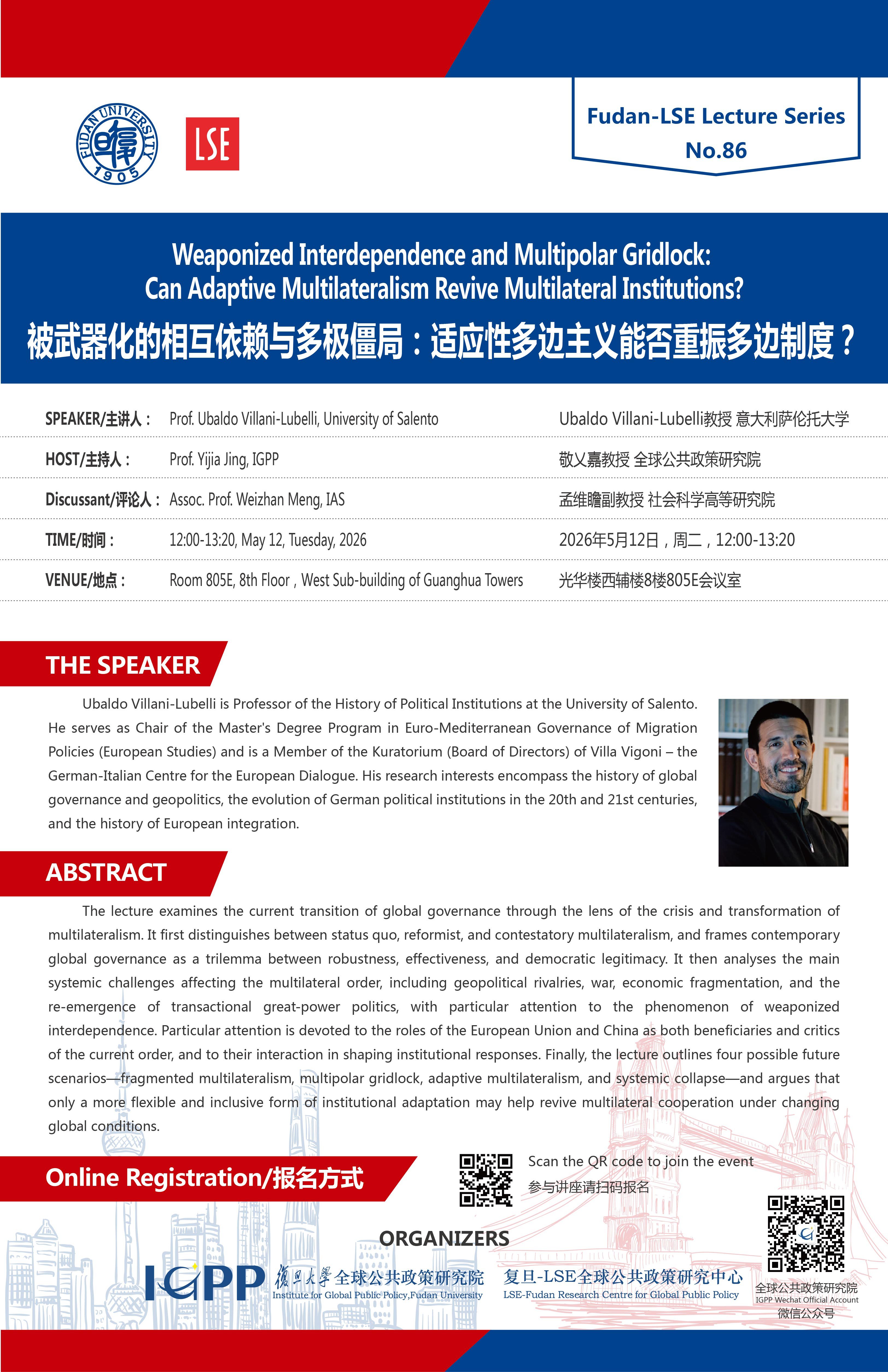
- Room 805E, 8th Floor, West Sub-building of Guanghua Towers 光华楼西辅楼8楼805E会议室
- 报告人:
- Prof. Ubaldo Villani-Lubelli
- 学校:
- 复旦大学
- 关键词:
- multilateralism, global governance, weaponized interdependence, multipolar gridlock, adaptive multilateralism, geopolitical rivalry, European Union, China
- 简介:
- The lecture examines the current transition of global governance through the lens of the crisis and transformation of multilateralism. It first distinguishes between status quo, reformist, and contestatory multilateralism, and frames contemporary global governance as a trilemma between robustness, effectiveness, and democratic legitimacy. It then analyses the main systemic challenges affecting the multilateral order, including geopolitical rivalries, war, economic fragmentation, and the re-emergence of transactional great-power politics, with particular attention to the phenomenon of weaponized interdependence. Particular attention is devoted to the roles of the European Union and China as both beneficiaries and critics of the current order, and to their interaction in shaping institutional responses. Finally, the lecture outlines four possible future scenarios—fragmented multilateralism, multipolar gridlock, adaptive multilateralism, and systemic collapse—and argues that only a more flexible and inclusive form of institutional adaptation may help revive multilateral cooperation under changing global conditions.
- -/- 2
报告介绍:
The lecture examines the current transition of global governance through the lens of the crisis and transformation of multilateralism. It first distinguishes between status quo, reformist, and contestatory multilateralism, and frames contemporary global governance as a trilemma between robustness, effectiveness, and democratic legitimacy. It then analyses the main systemic challenges affecting the multilateral order, including geopolitical rivalries, war, economic fragmentation, and the re-emergence of transactional great-power politics, with particular attention to the phenomenon of weaponized interdependence. Particular attention is devoted to the roles of the European Union and China as both beneficiaries and critics of the current order, and to their interaction in shaping institutional responses. Finally, the lecture outlines four possible future scenarios—fragmented multilateralism, multipolar gridlock, adaptive multilateralism, and systemic collapse—and argues that only a more flexible and inclusive form of institutional adaptation may help revive multilateral cooperation under changing global conditions.
报告人介绍:
Ubaldo Villani-Lubelli is Professor of the History of Political Institutions at the University of Salento. He serves as Chair of the Master's Degree Program in Euro-Mediterranean Governance of Migration Policies (European Studies) and is a Member of the Kuratorium (Board of Directors) of Villa Vigoni – the German-Italian Centre for the European Dialogue. His research interests encompass the history of global governance and geopolitics, the evolution of German political institutions in the 20th and 21st centuries, and the history of European integration.
报告图片:


购买下会员支持下吧...用爱发电已经很久了 立即购买

